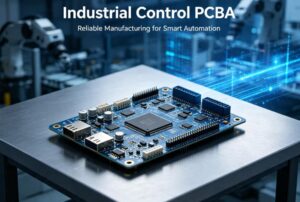
Industry 4.0 transformation is reshaping every layer of global manufacturing, and the industrial control PCBA supply chain is no exception. As factories adopt IIoT connectivity, edge computing and digital twin technologies, the control hardware powering these systems becomes increasingly sophisticated. For PCBA suppliers serving the industrial control sector, standing still means falling behind.
The global industrial automation market grows at an 8.75% CAGR, driven by intelligent factory upgrades worldwide. Next-generation PLCs, servo drives and industrial edge controllers demand higher circuit density, smarter production traceability and more flexible manufacturing models than traditional control hardware. Suppliers that once succeeded at high-volume, low-mix standard boards must now adapt to a new era of customized, data-driven production. This article explores four key evolutionary trends reshaping industrial PCBA manufacturing and what they mean for equipment OEMs.
1. Trend 1: High-Density Interconnect for Miniaturized Intelligent Hardware
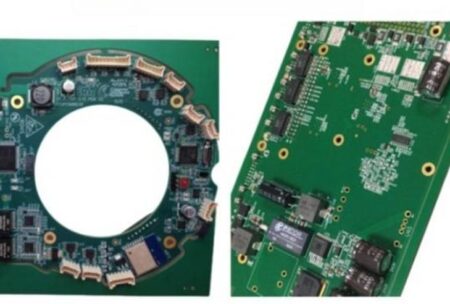
The first and most visible trend is the shift toward higher circuit density. Early industrial control boards were large, simple two-layer or four-layer designs with through-hole components. Modern intelligent controllers integrate multi-core processors, FPGAs, high-speed communication interfaces and analog acquisition channels on a single board, requiring HDI (High-Density Interconnect) PCB construction with microvias and fine trace geometries.
Miniaturization brings tangible benefits for industrial customers: smaller control cabinets, reduced wiring complexity and higher system integration. It also raises the technical bar for PCBA suppliers. Manufacturing HDI industrial boards demands precision laser drilling, tight impedance control and advanced BGA/QFN assembly capabilities that general-purpose SMT shops often lack.
Moving forward, this trend will accelerate as edge AI processing moves directly onto industrial control hardware. Suppliers without HDI fabrication and fine-pitch assembly expertise will be unable to support next-generation industrial control designs.
2. Trend 2: Full Digital Traceability for Quality Accountability
Industry 4.0 prioritizes transparency and data-driven decision making at every supply chain stage. For industrial control OEMs, full production traceability is no longer a nice-to-have — it is a requirement for quality management, regulatory compliance and after-sales support.
Modern PCBA suppliers implement MES (Manufacturing Execution Systems) that track every board through the entire production journey. These systems record which machine processed each assembly, which reflow profile was used, which component lots were installed and which inspector performed final quality checks. Data is logged at serial number level, enabling precise root-cause analysis if field issues ever arise.
Beyond internal quality management, digital traceability simplifies compliance audits for CE, UL and industry-specific certifications. For end customers in regulated sectors such as energy and pharmaceuticals, complete production records are an essential procurement requirement.
3. Trend 3: Flexible Manufacturing for High-Mix, Low-Volume Customization
Traditional industrial control production favored large batches of standardized board designs. Today, market demand is fragmenting as OEMs develop specialized control hardware for niche applications and customized automation solutions. This creates a growing need for high-mix, low-volume PCBA manufacturing.
Flexible production lines with rapid changeover capability are the answer. Advanced suppliers use modular production cells, automated program loading and smart material handling to switch between different board designs efficiently. This allows them to cost-effectively handle prototype runs, pilot batches and medium-volume production without the long setup times and high minimum order quantities of traditional mass production lines.
This flexibility directly benefits industrial OEMs by reducing time-to-market for new products and lowering inventory risk. Instead of committing to large production runs, customers can scale orders incrementally as market demand develops.
4. Trend 4: AI-Enhanced Quality Inspection for Higher Consistency
Human visual inspection has inherent limits in consistency and fatigue resistance, especially for high-density boards with hundreds of tiny components. The latest generation of PCBA production lines integrates AI-powered optical inspection systems that detect defects with greater accuracy and fewer false alarms than conventional AOI.
AI-trained inspection algorithms identify subtle soldering issues, component placement deviations and board defects that human inspectors and legacy AOI systems would miss. This improves first-pass yield and reduces the likelihood of defective assemblies reaching customers. For industrial control applications where reliability is paramount, AI-enhanced quality control represents a meaningful step forward in consistency.
Beyond inspection, AI is also being applied to predictive maintenance of production equipment, process parameter optimization and supply chain demand forecasting — all of which contribute to more stable, reliable PCBA supply.
What This Evolution Means for Industrial Control OEMs
For equipment manufacturers, these supplier-side changes create both opportunities and expectations. Working with a forward-looking PCBA partner enables shorter product development cycles, higher product reliability and smoother scale-up from prototype to production. Conversely, suppliers still operating on legacy consumer-electronics models will struggle to meet modern industrial control requirements.
Ring PCB has proactively invested in all four evolutionary areas to serve the evolving needs of industrial control customers. Our production facility supports HDI multilayer PCB fabrication and precision fine-pitch assembly, making us well positioned for the trend toward miniaturized intelligent control hardware.
We operate a fully integrated MES platform that provides serial-level traceability for every board, from raw material incoming inspection through final testing. Customers receive complete production documentation including component lot records, process parameters and inspection results, simplifying compliance and quality audits.
Our flexible manufacturing setup handles prototype quantities of five units through volume production of tens of thousands, with fast changeover between board designs to support high-mix product portfolios. We have also integrated AI-enhanced AOI inspection into our quality workflow, improving defect detection accuracy and ensuring consistent assembly quality across all production volumes.
Conclusion
Industry 4.0 is fundamentally transforming how industrial control PCBA is designed, manufactured and validated. Higher density, digital traceability, flexible production and intelligent quality control are no longer futuristic concepts — they are baseline requirements for serving modern industrial automation customers. PCBA suppliers that fail to evolve will find themselves increasingly unable to support next-generation control hardware.
For industrial control OEMs, selecting a supplier that embraces these trends ensures that their manufacturing partner can grow with their product roadmap, supporting both current requirements and future technology upgrades.
If you are looking for a forward-thinking PCBA supplier for your industrial control product line, share your current and future project requirements with us at rfq@ringpcb.com. Our team will outline how our manufacturing capabilities align with your long-term technology roadmap.