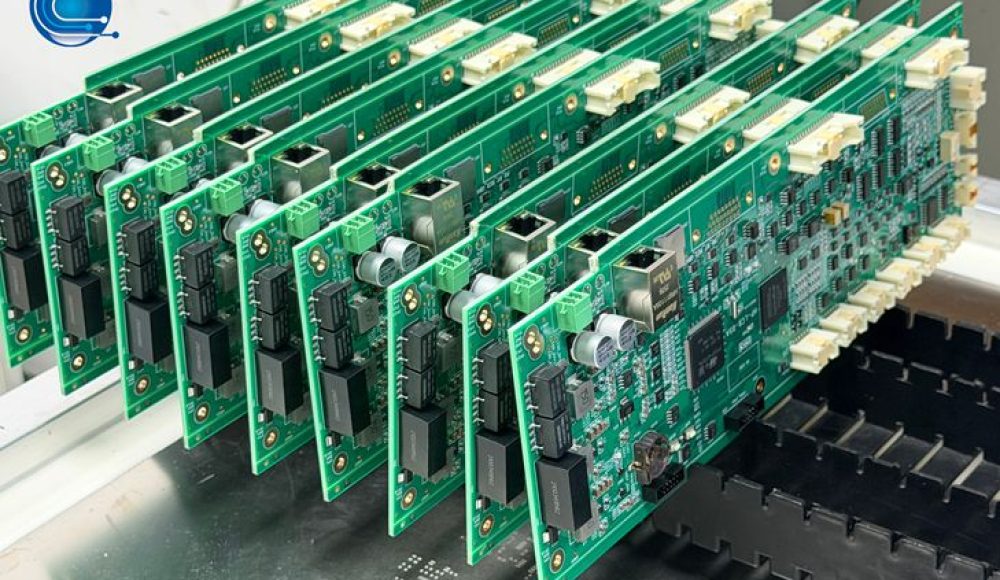
The global industrial control printed circuit board market is projected to reach USD 12.81 billion in 2026, driven by widespread Industry 4.0 upgrades and smart factory adoption worldwide. As industrial equipment grows more specialized, off-the-shelf control boards can no longer meet the unique performance, environmental and mechanical requirements of modern automation systems. For OEMs and system integrators, selecting and customizing the right PCBA partner directly determines product reliability, maintenance costs and long-term market competitiveness.
Unfortunately, many procurement teams focus primarily on unit pricing and overlook hidden quality risks embedded in the customization process. Industry statistics show that 81.7% of field failures in industrial PCBs stem from design flaws, poor material selection or inconsistent process control — issues that could have been avoided with proper upfront planning and supplier vetting. This guide breaks down the end-to-end workflow for sourcing and customizing high-quality industrial control PCBA, from requirement definition to mass production validation, to help buyers make informed decisions and reduce total lifecycle costs.
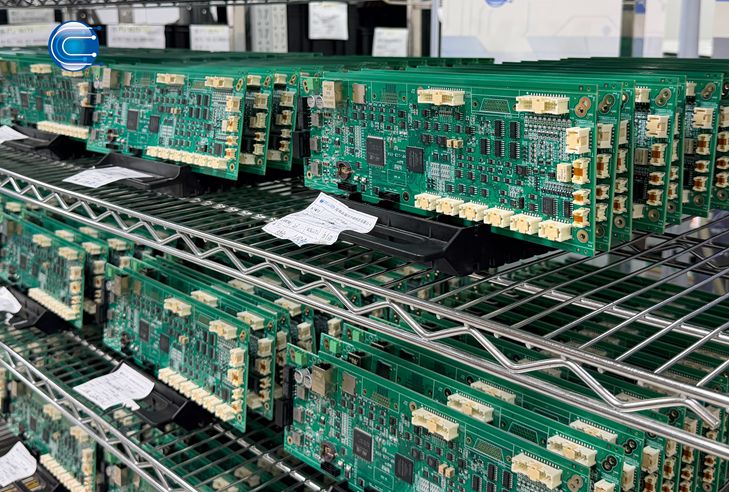
Step 1: Define Core Application Requirements Before Sourcing
First and foremost, quality customization starts with clear, well-documented application requirements, not with requesting quotes. Too many projects run into quality issues because buyers share only Gerber files without explaining the operating context.
Start by clarifying three foundational parameters. First, define the environmental severity: will the board operate in a climate-controlled cabinet, or will it face -40°C to 85°C temperature swings, constant mechanical vibration and heavy electromagnetic interference on a factory floor? These conditions dictate material grade, component rating and assembly reinforcement requirements. Second, set the expected service life. Industrial control equipment typically serves 10 to 15 years, which demands long-lifecycle components and stable supply chains, unlike consumer electronics with 2 to 3 year lifespans. Third, specify compliance and quality standards, such as IPC-A-610 Class 2 or Class 3 acceptance criteria and any industry-specific certification needs.
Taking the time to formalize these requirements upfront allows suppliers to propose appropriate material and process solutions, rather than defaulting to the cheapest options that may fail in real-world operation.
Step 2: Key Customization Decisions That Shape Long-Term Reliability
Moving from requirements to design, several customization decisions have an outsized impact on long-term reliability and deserve close attention during the engineering review phase.
The first decision is base material and copper weight. Standard Tg-130 FR-4 works for mild indoor environments, but industrial control applications should specify high-Tg FR-4 (Tg 170°C+) for improved dimensional stability and thermal cycling resistance. For power-intensive control boards, heavy copper construction (2–6 oz) improves current carrying capacity and heat dissipation, reducing thermal stress on solder joints.
Equally critical is early DFM (Design for Manufacturability) collaboration with the assembly partner. Many common failure modes — including via plating voids, solder joint fatigue and delamination — originate from suboptimal layout choices that could be corrected at the design stage. A supplier that provides proactive DFM feedback before production can reduce field failure rates significantly and improve first-pass yield.
Finally, component grade selection cannot be an afterthought. Industrial-grade components with extended temperature ratings and longer product lifecycles may carry a modest price premium, but they prevent premature obsolescence and drift-related failures over the equipment’s service life.
Step 3: Process Control Standards to Verify With Your Supplier
Once the design is finalized, the next step is evaluating how the supplier executes manufacturing and quality control. Consistent process discipline is what separates reliable industrial-grade assemblies from low-cost consumer-grade alternatives.
Industry defect analysis shows that BGA voiding accounts for 32% of assembly quality issues, followed by fine-pitch connector bridging at 24% and insufficient through-hole solder wetting at 18%. Top-tier suppliers mitigate these risks through statistical process control, optimized stencil design and calibrated reflow profiles. When vetting candidates, ask for concrete evidence: do they monitor reflow temperature profiles for every production run? Do they perform 100% AOI inspection, and X-ray analysis for BGA and QFN components? What is their typical first-pass yield for industrial control projects?
Traceability is another non-negotiable for industrial applications. Reputable manufacturers use MES systems to track component lot numbers, process parameters and inspection records at the serial number level. Full traceability simplifies root-cause analysis if field issues ever arise and supports compliance audits for regulated sectors.
Step 4: Validation Gates Before Committing to Mass Production
Last but by no means least, never skip structured validation between prototype and full production. Rushing directly from sample approval to volume orders is a common and costly mistake.
Start with First Article Inspection (FAI) on the initial production batch, verifying dimensions, component values, solder quality and electrical performance against the approved specification. For high-reliability applications, add environmental reliability testing — thermal cycling, vibration screening and accelerated aging — to validate performance under simulated field conditions.
It is also advisable to run a small pilot batch of 50 to 200 units before full scale-up. Pilot production reveals process consistency issues that may not appear in a handful of prototypes and gives both teams a chance to fine-tune the manufacturing workflow. A stable pilot run with first-pass yield above 95% is a reliable indicator of smooth mass production.
How Ring PCB Delivers Custom Industrial Control PCBA Quality
Ring PCB brings 18 years of specialized PCB fabrication and assembly experience to every industrial control project. We operate 10,000 square meters of modern self-owned factories in Shenzhen and Zhuhai with a 500-member professional team, and our facilities hold ISO 9001, ISO 14001, ISO 13485 and IATF 16949 certifications.
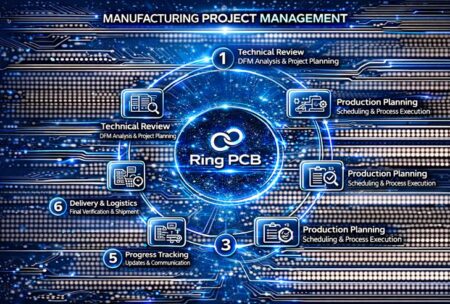
Our customization workflow aligns with the quality-first approach outlined above. We provide complimentary DFM review for every incoming design, flagging manufacturability and reliability concerns before production begins to reduce downstream failures. All assemblies are manufactured to IPC-A-610 standards, with 100% AOI coverage and X-ray inspection for fine-pitch components. Our integrated MES system ensures full batch traceability from raw material incoming inspection through final testing.
We support fast prototype turnaround within 3 working days and mass production delivery in 7 days, helping customers accelerate product launch schedules. As a full-turnkey EMS provider, we handle PCB fabrication, authorized component sourcing, precision SMT/DIP assembly and comprehensive testing under one roof. Our solutions serve clients across industrial control, communication, medical device, EV charging and other sectors, with products exported to more than 50 countries and regions.
Conclusion
High-quality industrial control PCBA is not simply purchased — it is achieved through clear requirement definition, collaborative design optimization, rigorous process control and structured validation. By following a structured sourcing and customization workflow, OEMs can avoid the majority of common quality failures and reduce total cost of ownership over the equipment lifecycle. The right manufacturing partner does more than assemble boards; they act as a technical ally that improves design robustness and production consistency.
If you are planning a custom industrial control PCBA project and would like a professional DFM assessment and quotation, share your Gerber files, BOM and application details with us at rfq@ringpcb.com. Our engineering team will respond with a tailored solution within 24 working hours.