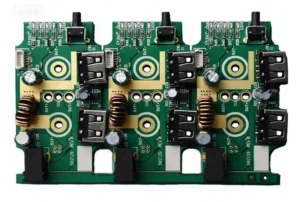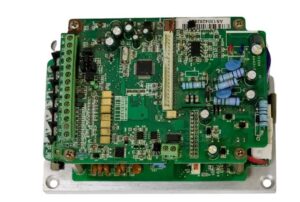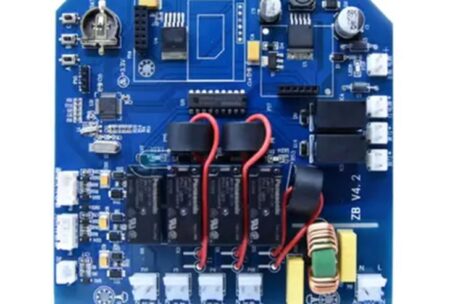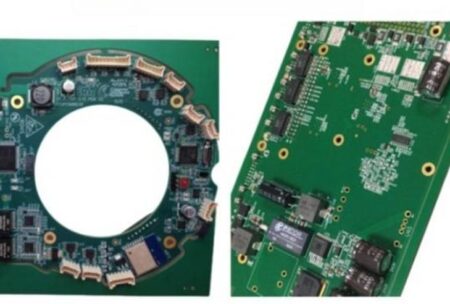
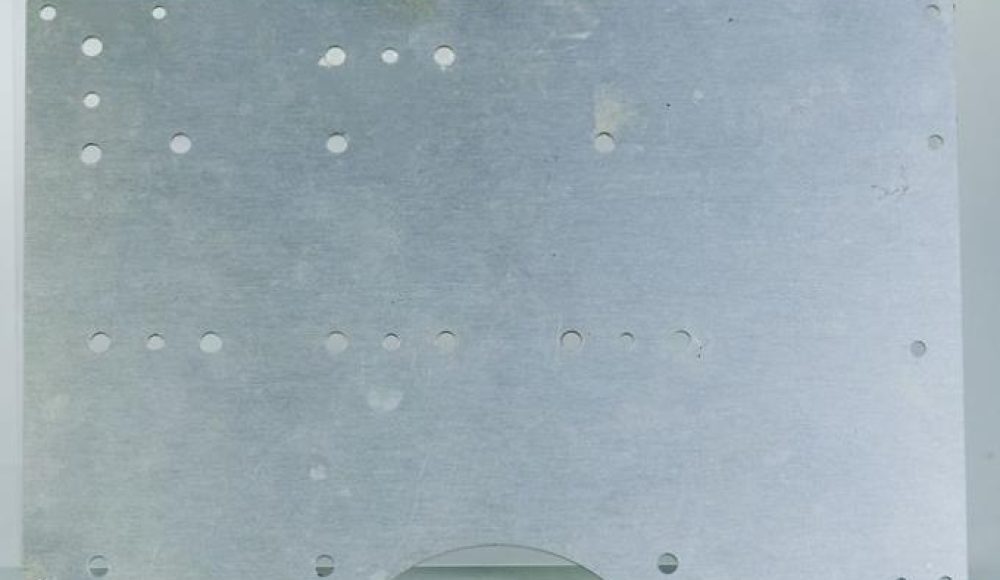
Aluminum PCB board & assembly is commonly used in power electronics where heat is a limiting factor rather than just a design parameter.
Compared with standard FR-4 boards, metal-core PCBs behave differently under thermal and mechanical stress. The difference becomes more obvious as power density increases in automotive, LED, and industrial systems.
Ring PCB develops aluminum PCB solutions for applications where thermal stability directly affects product lifetime and field reliability.
How an Aluminum PCB Is Structured
An aluminum PCB is built as a three-layer structure:
- Copper layer for current routing
- Dielectric layer for insulation and heat transfer
- Aluminum base for heat spreading
Each layer plays a different role. The dielectric layer is usually the most critical part because it controls both heat flow and electrical isolation.
Typical thermal conductivity ranges are:
- Standard materials: 1.0–4.0 W/m·K
- High-performance materials: up to 6.0–8.0 W/m·K
In real designs, performance depends more on how consistent this layer is than on the aluminum itself.
Why Thermal Problems Cause Most Failures
In power electronics, failures usually do not come from circuit design. They come from heat buildup over time.
Common issues include:
- Power devices running too hot at local junctions
- Insulation aging under continuous voltage stress
- Solder joints cracking after repeated heating and cooling
- Mechanical stress from vibration in real environments
These problems build up slowly. That is why thermal design has a direct impact on product lifetime.
Aluminum PCB helps by spreading heat more evenly across the board instead of letting it concentrate in one area.
What Makes Aluminum PCB Manufacturing Different
Producing aluminum PCB is more sensitive than standard PCB manufacturing.
Some key challenges include:
- Keeping dielectric thickness stable across large panels
- Preventing board warpage during lamination
- Maintaining flatness for SMT assembly accuracy
- Controlling drilling wear caused by aluminum hardness
Even small variations in these areas can change thermal performance in production.
That is why process stability matters more than prototype performance when scaling to volume production.
Integrated PCB and Assembly Production
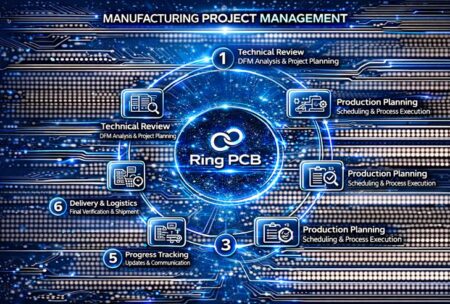
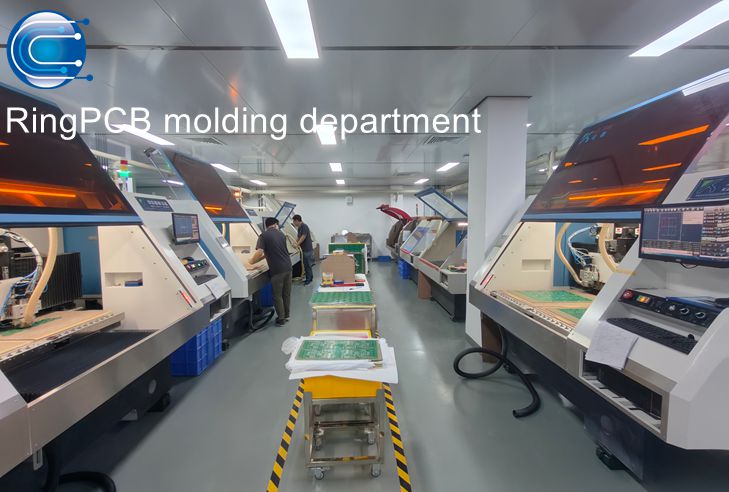
Ring PCB operates PCB fabrication and assembly under one production system.
This includes:
- PCB manufacturing capacity up to 50,000㎡ per week
- SMT assembly for both prototypes and mass production
- Component sourcing, assembly, and electrical testing
Keeping fabrication and assembly in one system reduces variation between processes and improves overall yield stability.
Where Aluminum PCB Is Actually Used
Aluminum PCB is not used everywhere. It is selected when heat becomes a real constraint.
Typical applications include:
- Automotive power control systems
- LED lighting and driver modules
- Industrial motor control units
- DC power conversion systems
In these systems, thermal stability often matters more than circuit complexity.
Quality and Compliance
Ring PCB operates under international manufacturing standards:
- ISO9001
- ISO14001
- ISO13485
- IATF16949
- UL certification
These systems help keep production consistent from prototype stage to mass production.
How Engineers Usually Evaluate Suppliers
When engineers choose an aluminum PCB supplier, they usually focus on a few practical points:
- Whether thermal requirements can be consistently met
- Whether boards remain flat enough for SMT assembly
- Whether production scales without yield loss
- Whether traceability and quality systems are in place
In most cases, long-term reliability depends more on manufacturing control than on material specifications.
Conclusion
Aluminum PCB board & assembly is used in systems where thermal behavior directly affects reliability.
It is not just a material upgrade. It is a way to control heat flow at system level and reduce long-term failure risk.
With integrated manufacturing capability, Ring PCB supports engineers from early prototypes to stable mass production with consistent process control.