Introduction
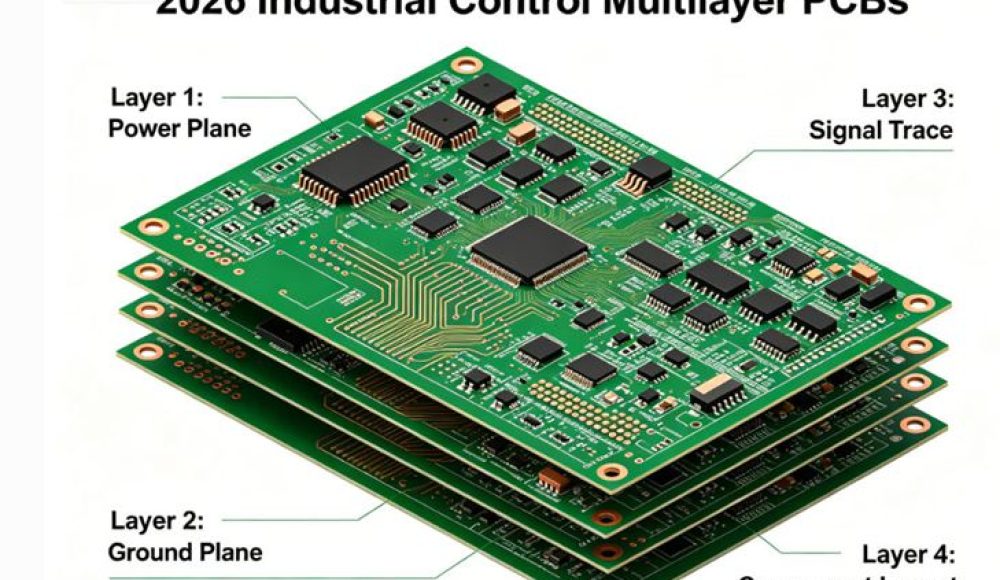
Driven by rapid upgrades in industrial automation, smart manufacturing, and robotic control systems, the globalIndustrial Control Multilayer PCBs market continues strong growth in 2026, with industry analysts forecasting the market size to exceed $11.2 billion and maintain a 13% year-over-year growth rate. As modern industrial devices trend toward high density, multi-layer stacking, and high power output, standard Industrial Control Multilayer PCBs ranging from 6-layer to 16-layer have become the mainstream hardware carrier for PLC controllers, servo drive systems, industrial gateways, and automated production equipment. For complex high-end industrial and smart factory projects, high-layer Multilayer PCBs up to 48 layers are increasingly adopted to support high-speed signal transmission and compact mechanical design.
Even so, field reliability data from industrial OEMs reveals a persistent industry pain point: 72% of unplanned industrial equipment downtime is caused by thermal failure of Industrial Control Multilayer PCBs. Under long-term high-load operation and repeated thermal cycling ranging from -40°C to 125°C, conventional ordinary FR-4 substrates used in generic Multilayer PCBs are prone to layer delamination, via cracking, signal offset, and local overheating, greatly shortening the service life of industrial control equipment.
From our long-term cooperation with industrial customers in 2026, we have summarized the most concerned core questions of design engineers and procurement teams: Which new PCB materials can effectively improve thermal stability for high-layer industrial boards? How to balance high-reliability performance, stable mass production, and comprehensive cost control? How to avoid hidden thermal risks in the early design stage?
This blog will combine the latest industrial PCB material innovations, real industry failure data, and practical manufacturing experience to analyze how modern Industrial Control Multilayer PCBs technology solves thermal reliability challenges in complex industrial scenarios.
1. 2026 Core Material Innovations Solving Thermal Bottlenecks for Industrial Control Multilayer PCBs
With increasingly strict industrial equipment lifespan requirements (most new projects require 10+ years of stable operation), traditional Tg130–140°C ordinary substrates can no longer meet long-term thermal cycling demands for high-performance Industrial Control Multilayer PCBs. In 2026, three material upgrade directions have become the mainstream standard for high-reliability industrial multilayer PCBs.
1.1 High-Tg Low-CTE Industrial-Grade Substrates Become Standard
High-Tg substrates with Tg ≥170°C and ultra-low Z-axis thermal expansion coefficient have gradually replaced ordinary materials and become the preferred solution for 8-layer and above industrial control boards. This material effectively reduces structural deformation during rapid temperature changes, improving thermal shock resistance by more than 40% and avoiding layer separation and hole wall fracture after thousands of cold and hot cycles.
In daily DFM reviews, our RingPCB engineering team will actively match high-Tg, low-CTE substrate schemes according to customer application scenarios such as outdoor industrial control, high-temperature workshops, and automated production lines. For projects with high environmental reliability requirements, we will proactively optimize stackup structures to eliminate hidden thermal dangers in advance, instead of simply following conventional material matching.
1.2 Low-Roughness Heavy Copper Foil Optimizes High-Current Heat Dissipation
High-power industrial control boards usually carry large current loads, and unreasonable copper thickness and foil roughness easily lead to local heat accumulation and temperature rise. The upgraded low-profile heavy copper foil technology in 2026 can significantly reduce thermal resistance while ensuring precise signal transmission, making the heat distribution of the whole board more uniform.
In many servo drive and power control multilayer PCB projects we serve, the optimized 2oz–6oz heavy copper layout effectively reduces the peak temperature of key power circuits by 12%–18% under full-load operation, greatly improving the long-term stability of the equipment.
1.3 Embedded Copper Coin Thermal Dissipation Technology for Compact High-Power Modules
For high-density, multi-layer, and limited-space industrial control modules, traditional heat dissipation methods are insufficient. Embedded copper coin thermal dissipation technology forms an internal high-efficiency heat conduction channel inside the multilayer board, quickly exporting core heat and solving the thermal runaway problem of high-power IGBT and MOS tube circuits.
RingPCB supports embedded copper coin processing for 6–48 layer industrial PCBs through automated lamination and precise pressing technology, providing reliable thermal structure solutions for high-end robotic control and industrial power equipment customers with high-layer and high-density design demands.
2. Top 4 Thermal Reliability Pain Points of Industrial Control Multilayer PCBs (2026 Industry Data)
Based on statistics from our long-term service of industrial automation customers and industry field failure reports, the following four thermal problems are the most likely to cause project failures and after-sales losses, and are also the key assessment indicators for customers when selecting PCB suppliers.
2.1 Layer Delamination and Via Failure Caused by Thermal Cycling
48% of industrial OEMs have encountered quality problems such as board bulging and hole wall cracking after equipment operation for 1–2 years. The root cause is the mismatch of thermal expansion coefficients of substrates and prepregs, leading to structural fatigue after repeated temperature shocks.
All RingPCB industrial multilayer boards adopt symmetric stackup design and strictly screened industrial-grade materials. Each batch will pass professional thermal cycling tests from -40°C to 125°C and high-temperature and high-humidity aging tests to ensure stable peel strength and structural consistency for long-term operation.
2.2 Unstable Supply of High-Performance Thermal Materials
In 2026, the global supply of high-end industrial substrates is still tight. Many small and medium-sized PCB factories face delayed delivery and material replacement risks, which indirectly affect the mass production progress of industrial equipment.
We have long-term stable cooperative relations with well-known substrate suppliers and maintain safety inventory of high-Tg substrates and heavy copper materials all year round. Through dual-source supply mechanism and standardized material reserve management, we effectively shorten the proofing and mass production cycle of high-reliability industrial boards and avoid project delays caused by material shortages.
2.3 Undetected Thermal Design Defects Leading to Batch Risks
Many PCB manufacturers only conduct basic electrical testing, lacking professional thermal simulation and full-load aging verification. 36% of customers have reported that samples passed testing but had large-area overheating problems after mass installation.
Different from ordinary manufacturers, RingPCB’s reliability laboratory supports full-board thermal mapping, hot spot analysis, and long-term load aging testing. In the early DFM stage, our engineers will actively optimize thermal via distribution, copper area layout, and stackup structure according to customer power distribution characteristics, helping customers avoid design defects in advance.
2.4 Difficulty Balancing Reliability and Comprehensive Cost
Many design teams are worried that upgrading high-performance materials will increase upfront costs, but ignore the huge after-sales maintenance and return losses caused by low-reliability boards in the later stage.
We always provide customers with transparent and objective cost-performance analysis, comparing the comprehensive benefits of different material schemes in the whole life cycle, helping industrial customers formulate the most suitable PCB reliability scheme for product positioning, and avoiding blind cost reduction or excessive configuration waste.
3. RingPCB’s Strengths in Manufacturing High-Reliability Industrial Control Multilayer PCBs
With 18 years of focus on high-reliability industrial PCB and PCBA manufacturing, RingPCB have formed a complete set of industrial-grade production, testing and customization systems for the thermal and high-density characteristics of modern industrial control boards, which can perfectly match the stringent quality requirements of 2026 industrial automation projects.
We support customized production of 6–48 layer industrial multilayer PCBs, equipped with LDI laser imaging, plasma desmear, and fully automated precision pressing lines, achieving ultra-stable impedance control and high-precision microvia processing. All products comply with ISO9001, IATF16949, RoHS, and REACH global industrial certification standards.
In terms of reliability testing, we have independent laboratories to complete thermal cycling, damp heat aging, CAF resistance, and vibration testing, with complete test reports traceable for each batch of products. For high-end industrial customers, we provide one-stop turnkey services from PCB fabrication, component procurement, SMT/THT assembly to final thermal burn-in testing, truly solving customer’s multi-link supply and quality risks.
4. Future Trends of Industrial Multilayer PCBs
As industrial equipment becomes more intelligent, high-power, and miniaturized, the thermal management pressure of multilayer PCBs will continue to increase. In the future, high-Tg low-loss substrates, composite heat dissipation structures, and more refined stackup optimization will become the core competitiveness of high-end industrial PCB manufacturing. At the same time, OEMs will pay more attention to long-term reliability and supply chain stability rather than simply pursuing low unit prices.
In this increasingly stringent industrial manufacturing environment, only manufacturers with professional material matching capabilities, complete reliability verification systems, and stable mass production capacity can help equipment brands maintain long-term market competitiveness.
Conclusion
Material innovation and thermal reliability are the two core pillars of 2026 Industrial Control Multilayer PCBs design and manufacturing. Facing complex and changeable industrial application scenarios, only by selecting scientific substrate schemes, optimizing thermal structures, and strictly controlling production and testing links can we effectively avoid equipment downtime and after-sales risks for high-precision Multilayer PCBs.
Material innovation and thermal reliability are the two core pillars of 2026 industrial control multilayer PCB design and manufacturing. Facing complex and changeable industrial application scenarios, only by selecting scientific substrate schemes, optimizing thermal structures, and strictly controlling production and testing links can we effectively avoid equipment downtime and after-sales risks.
If you are developing high-layer Industrial Control Multilayer PCBs and want to optimize thermal design, or need professional material matching and DFM risk assessment for your new project, our professional industrial PCB engineering team is always ready to provide free technical analysis and customized solutions.
You can send your Gerber files and project requirements to rfq@ringpcb.com, and we will help you screen the most reliable and cost-effective industrial PCB manufacturing solution for your application scenarios.
To learn more about industrial multilayer PCB reliability cases and thermal optimization technologies, welcome to browse our official website:https://www.ringpcb.com