The global smart robot industry continues rapid expansion in 2026, driven by widespread factory automation, commercial service robot adoption, and Industry 4.0 intelligent upgrading. According to the latest MarketsandMarkets industry report, the global industrial robotics market is projected to reach $15.5 billion this year, with robot networking and communication hardware growing at a CAGR of 9.9% — one of the fastest-growing segments in the entire robotics supply chain.
As AMRs (Autonomous Mobile Robots), collaborative cobots, and intelligent service robots become increasingly connected and data-driven, communication PCBA reliability has evolved from a secondary accessory requirement into a core decisive factor for overall robot stability. IDC’s 2026 industrial hardware survey reveals a striking industry pain point: 61% of robot equipment failures and operational downtime are caused by unstable wireless communication, signal interference, or low-quality communication board assembly, rather than mechanical or algorithm errors.
In recent industry standards updates and global robotics tender requirements,IATF 16949 certification has gradually become a unified threshold for high-end robot networking hardware. Unlike ordinary ISO9001 manufacturing standards, IATF16949 focuses on zero-defect manufacturing, full lifecycle traceability, and anti-failure process control — perfectly matching the long-cycle, high-vibration, high-interference working environment of smart robots. This article analyzes why IATF-certified communication PCBA has become the mainstream solution for modern smart robot networking systems and summarizes the key technical standards required for next-generation robot communication hardware.
1. Why Smart Robot Networking Requires IATF16949-Certified Communication PCBA?
Smart robot communication scenarios differ greatly from conventional consumer IoT devices. Robots operate in dynamic and harsh industrial environments: continuous mechanical vibration, frequent temperature cycling, strong electromagnetic interference from drive motors, and 24/7 long-term standby operation. Under such conditions, ordinary commercial-grade communication PCBA often suffers from signal dropout, solder joint fatigue, RF attenuation, and intermittent disconnection after long-term operation.
IATF 16949, originally formulated for automotive high-reliability electronic systems, introduces stricter quality control mechanisms including FMEA risk prediction, APQP advanced product quality planning, PPAP production approval, and SPC statistical process control. These standardized mechanisms effectively avoid batch quality fluctuations and hidden reliability risks that commonly exist in general PCBA production.
Industry verification data shows that robot devices equipped with IATF16949-certified communication PCBA can reduce communication-level failure rates by 72% and extend overall equipment service life by more than 30%. As a result, mainstream automation brands and robot OEMs have successively incorporated IATF16949 qualification into their core supplier access standards in 2025–2026.
2. Core Technical Requirements for Modern Robot Communication PCBA
With the upgrading of robot fleet scheduling, multi-sensor fusion, and cloud remote management capabilities, communication PCBA is no longer limited to simple signal transmission. It needs to support multi-channel concurrent data collection, low-latency wireless interaction, and long-term stable industrial networking.
Current mainstream high-performance robot communication PCBA presents three typical technical characteristics:
-
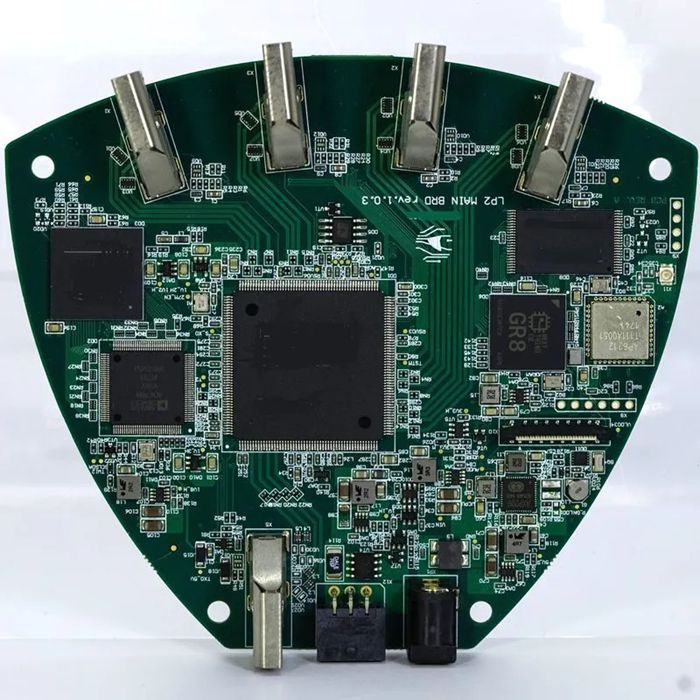
Dual-mode RF wireless integration: Integrated WiFi and Bluetooth modules with complete RF impedance matching and independent shielding design to resist motor EMI interference, ensuring stable wireless pairing, data uploading, and OTA remote upgrading.
-
Multi-channel high-speed data interface: Multi-group USB high-speed channels and reserved industrial bus terminals support simultaneous access to multiple cameras, LiDAR, environmental sensors, and positioning modules, realizing multi-source data synchronous transmission.
-
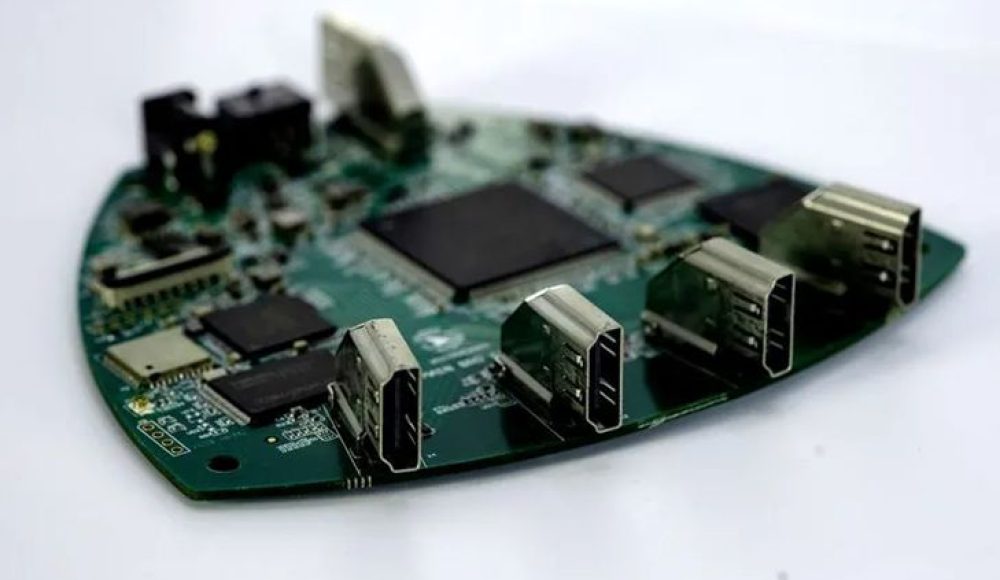
Custom adaptive structural design: Special irregular and fan-shaped PCB layouts are widely adopted to adapt to the compact and curved internal space of service robots and inspection robots, achieving structural fit without sacrificing circuit stability.
Different from single-function communication boards, robot-dedicated communication PCBA emphasizes real-time performance, anti-interference capability, and batch consistency — the core reasons why automotive-grade certification systems are increasingly referenced in robot hardware manufacturing.
3. Standard Specifications of IATF16949-Grade Robot Communication PCBA
The following industrial-grade parameters have become the mainstream benchmark for new-generation smart robot networking communication PCBA:
|
Item
|
Technical Specifications
|
|---|---|
|
PCB Layer Range
|
2–16 layers rigid PCB / customizable rigid-flex structure
|
|
Applicable Materials
|
High-Tg FR-4, low-CTE industrial substrate, automotive-grade material
|
|
Surface Treatment
|
ENIG, Immersion Silver, anti-oxidation RF dedicated process
|
|
Wireless Configuration
|
WiFi + Bluetooth dual-mode industrial RF module
|
|
External Interfaces
|
Multi-channel USB, expandable RS485 / CAN / UART bus
|
|
Working Temperature
|
-40℃ ~ +85℃ wide temperature resistance
|
|
Reliability Standard
|
IPC Class 3 & IATF16949 batch consistency control
|
|
Service Life
|
50,000+ hours continuous stable operation
|
4. Common Customization Trends for Robot Communication PCBA (2026 Industry Overview)
As robot application scenarios become more segmented, standardized communication boards can no longer meet differentiated equipment design requirements. Current industry customization trends are mainly concentrated in four directions:
1. Structural shape customization: Irregular outlines, fan-shaped structures, and special mounting hole positioning to adapt to personalized robot shell and internal space design.
2. RF performance customization: Adjustable communication frequency bands, high-gain external antenna expansion, and data encryption transmission for industrial security scenarios.
3. Interface configuration customization: Flexible adjustment of USB quantity, bus interface type, and power supply specifications according to sensor access requirements.
4. Environmental reliability customization: Conformal coating, moisture-proof, dust-proof, and anti-corrosion treatment for outdoor inspection robots and harsh factory environments.
5. Main Application Scenarios of Certified Robot Communication PCBA
IATF16949-certified communication PCBA is widely used in high-reliability robot networking scenarios, covering almost all mainstream intelligent mobile robot categories:
-
Industrial AMR/AGV Robots: Real-time data interaction and fleet scheduling communication for factory handling and logistics robots.
-
Collaborative Cobots: Communication relay between robotic arms, vision systems, and industrial cloud platforms.
-
Commercial Service Robots: Stable wireless networking for delivery robots, guidance robots, and exhibition interactive robots.
-
Inspection & Monitoring Robots: Long-distance data transmission for equipment patrol, pipeline detection, and security inspection robots.
-
Industrial IoT Gateway Terminals: Multi-device data convergence and protocol conversion for smart factory automation systems.
6. Industry Conclusion: Certification Becomes the New Threshold for Robot Hardware
In the past, robot communication PCBA was often regarded as a low-risk auxiliary component, but industry failure data and mass production practice have completely overturned this cognition. In the era of large-scale robot commercial deployment, communication stability determines equipment uptime, and standardized certification determines product long-term consistency.
IATF16949 certification is not merely a qualification certificate; it represents a complete set of industrial-grade risk control, process standardization, and full-lifecycle traceability systems. For robot OEMs and R&D teams, choosing IATF-certified communication PCBA manufacturing standards is the most effective way to reduce after-sales risks and improve product market competitiveness.
As robot networking technology continues to iterate, multi-functional integrated, high-stability, and fully standardized communication PCBA will become the mainstream configuration of the industry. Teams that pay attention to early DFM optimization, standardized process control, and certified manufacturing will gain greater advantages in product iteration and large-scale market promotion.
Contact RingPCB
If your team is developing or iterating smart robot networking hardware, understanding industrial-grade communication PCBA design and standardized manufacturing rules can effectively reduce batch failure rates and improve long-term equipment stability. Professional certified communication PCBA customization and DFM optimization support can help robot projects achieve faster prototype verification and more stable mass production delivery.
Submit your Gerber files, BOM and full application technical requirements via email to rfq@ringpcb.com, and Ring PCB‘s professional engineering team will provide free DFM analysis, stack-up optimization and customized quotation solutions.
Visit https://www.ringpcb.com to view more information.