Modern industrial automation, renewable energy systems, and high-power industrial equipment are evolving rapidly toward higher current density and continuous heavy-load operation. Standard 1oz to 2oz PCBs can no longer withstand long-term high-current transmission, frequent thermal cycling, and harsh factory operating conditions, often causing overheating, voltage drop, and unexpected equipment downtime. For high-current industrial scenarios, custom heavy copper PCB manufacturing has become an essential manufacturing solution to ensure equipment stability, efficiency, and service life. This article analyzes industry trends, core application values, and professional manufacturing standards for industrial heavy copper PCBs.
1. Industry Trend: Soaring Demand for Industrial High-Current Heavy Copper PCBs
In recent years, the global industrial power electronics sector has driven explosive growth in the heavy copper PCB market. According to 2026 industry market data, the heavy copper PCB industry maintains a steady annual growth rate of over 10%, far outpacing the traditional PCB market. Notably, more than 61% of new industrial power equipment designs adopt multilayer heavy copper structures to adapt to high-current and high-power operating requirements.
Furthermore, industrial high-current applications including frequency converters, industrial inverters, energy storage power supplies, and motor control systems account for the largest market share of heavy copper PCB consumption. Industry statistics show that over 67% of industrial power equipment failures are caused by insufficient current-carrying capacity and poor thermal dissipation of ordinary circuit boards. Therefore, customized heavy copper PCBs with 3oz to 10oz copper thickness have become the mainstream standard for high-current industrial equipment upgrading.
2. Core Pain Points of Standard PCBs in Industrial High-Current Scenarios
To begin with, traditional thin-copper PCBs face prominent technical bottlenecks in high-current industrial operation. When transmitting large currents, thin copper traces generate excessive resistance heat, leading to continuous temperature rise on the board surface. Long-term high-temperature operation not only reduces power conversion efficiency but also accelerates component aging and substrate deformation.
In addition, industrial equipment typically runs 24/7 with frequent start-stop cycles and severe temperature fluctuations. Ordinary PCBs are prone to trace delamination, solder joint fatigue and open circuits under repeated thermal and mechanical stress. These hidden faults directly trigger unplanned production line shutdowns, bringing huge economic losses to industrial manufacturers. For this reason, generic PCB solutions can hardly meet the long-term reliability requirements of high-current industrial applications.
3. Unique Advantages of Custom Heavy Copper PCBs for Industrial Scenarios
Compared with standard circuit boards, custom heavy copper PCBs provide targeted optimization for high-current industrial working conditions, bringing three core industrial values.
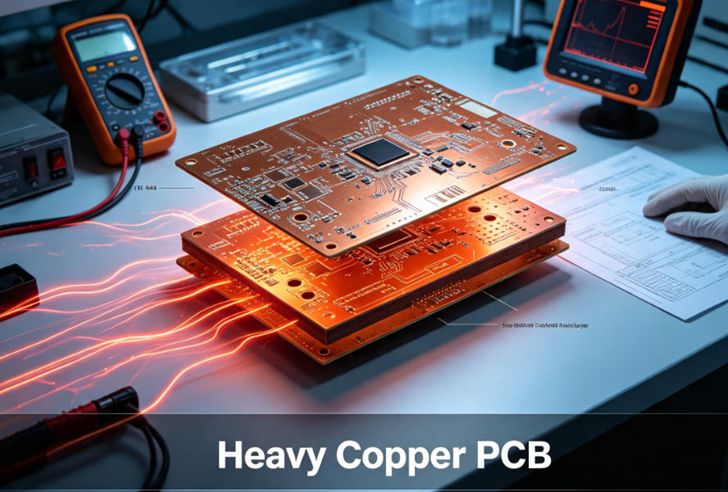
First, it delivers ultra-high current-carrying capacity. Custom 3–10oz thick copper traces greatly enhance current transmission efficiency, effectively reducing line resistance and voltage drop. This design perfectly adapts to high-current operation of industrial inverters, industrial power distribution modules and energy storage equipment, ensuring stable power output.
Second, it achieves excellent thermal management performance. Thick copper layers act as efficient heat dissipation channels, quickly conducting and diffusing heat generated by high-power components such as IGBT and MOSFETs. This significantly lowers the operating temperature of the entire board, reducing reliance on bulky heat dissipation structures and optimizing equipment volume and structure.
Third, customized manufacturing realizes scenario-based adaptation. Professional manufacturers can flexibly adjust copper thickness, trace width, layer stackup and thermal layout according to customers’ industrial equipment parameters, perfectly matching diverse high-current industrial design requirements and avoiding universal board performance limitations.
4. Professional Manufacturing Standards Determine Industrial-Grade Reliability
It is worth noting that heavy copper PCB production has high technical barriers. Over 40% of manufacturers face difficulties in precision etching, layer alignment and lamination stability during heavy copper production, resulting in inconsistent batch quality. Industrial high-current equipment requires zero-failure operation, which puts forward extremely strict standards for PCB manufacturing precision and stability.
As a professional industrial-grade PCB and PCBA manufacturing provider, Ring PCB has long focused on customized heavy copper solutions for high-current industrial applications. With 18 years of manufacturing experience and a 10,000㎡ self-owned standardized factory, we stably mass-produce 3oz to 12oz heavy copper PCBs, fully covering various high-power industrial equipment scenarios.
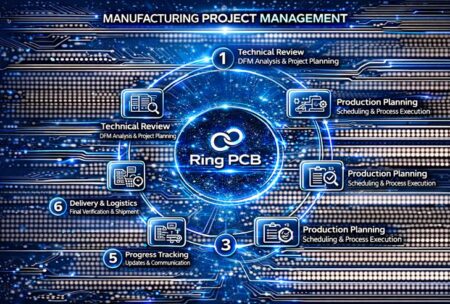
We strictly implement IPC Class 3 industrial standards and hold ISO9001, IATF16949 and UL certifications to ensure every board adapts to harsh industrial environments. Our professional engineering team provides free DFM optimization before production, optimizing trace layout and thermal design to avoid current overload and heat accumulation risks. Supported by full-process AOI optical inspection, X-ray detection and high-current load testing, we guarantee stable performance of heavy copper PCBs in long-term industrial heavy-load operation.
In addition, Ring PCB provides full-turnkey EMS services including PCB fabrication, component sourcing, precision SMT/THT assembly and finished product testing, supporting rapid prototype verification and large-scale mass production for industrial customers, greatly simplifying the customer’s supply chain process.
5. Conclusion
Overall, custom heavy copper PCB manufacturing is the core guarantee for stable, efficient and long-term operation of high-current industrial equipment. With the continuous upgrading of industrial automation and high-power energy equipment, customized heavy copper PCB solutions will become the standard configuration for high-end industrial power electronic systems.
If you have customized heavy copper PCB and PCBA manufacturing needs for industrial high-current equipment, please send your Gerber files, BOM lists and technical requirements to rfq@ringpcb.com. Our professional technical team will provide free DFM analysis and a competitive customized quotation within 24 hours.