Communication equipment manufacturers must balance product performance, component availability, production schedules, and long-term reliability. Whether developing wireless gateways, Ethernet switches, optical communication modules, or telecommunications controllers, OEMs often need to coordinate several specialized manufacturing processes.
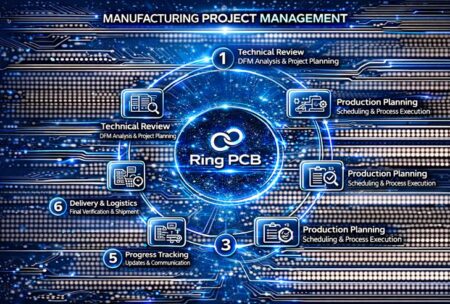
When PCB fabrication, component sourcing, SMT assembly, testing, and logistics are managed by separate suppliers, each handoff introduces additional coordination work.
Full-Turnkey Assembly Service offers an alternative by integrating these activities into a more connected manufacturing workflow.
For communication equipment OEMs, this approach can improve production visibility, simplify purchasing, and reduce avoidable manufacturing risks.
However, its value depends on the manufacturing partner’s engineering capabilities, sourcing discipline, and quality management.

Growing Network Demand Increases Manufacturing Complexity
Communication networks continue to evolve as 5G adoption expands and new services require higher performance.
According to Ericsson’s June 2026 Mobility Report, 5G subscriptions reached approximately 3.1 billion in the first quarter of 2026 and are forecast to reach 6.4 billion by 2031.
The report also highlights growing uplink traffic, increasing 5G Standalone deployment, and continued development toward 6G.
These trends do not translate directly into a specific PCBA production forecast, but they illustrate the technological demands facing network equipment developers.
Communication hardware must increasingly support high-speed data processing, reliable connectivity, efficient power management, and compact integration.
Consequently, manufacturing coordination becomes an important part of product development.
What Does a Full-Turnkey Assembly Service Include?
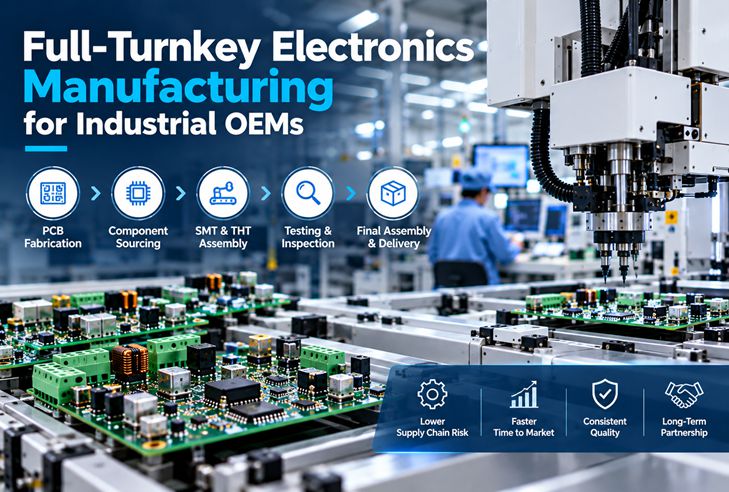
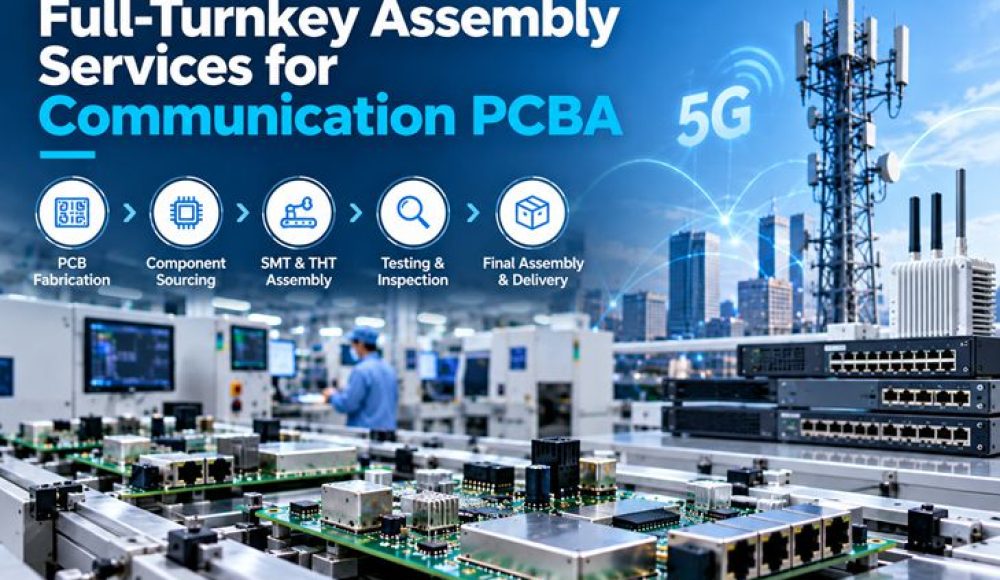
A full-turnkey service typically combines PCB fabrication, BOM review, component sourcing, SMT assembly, through-hole assembly, inspection, testing, and delivery.
Depending on the project, additional services may include programming, conformal coating, cable assembly, or box-build integration.
The OEM provides manufacturing information such as Gerber or ODB++ files, BOM, pick-and-place files, assembly drawings, and technical specifications.
The manufacturing partner reviews these documents and coordinates the agreed production stages.
Unlike consignment assembly, where the customer supplies some or all components, full-turnkey manufacturing generally places more sourcing responsibility with the EMS provider.
The goal is to simplify coordination without removing the OEM’s control over technical specifications and approved components.
Reducing Fragmented Supplier Management
Consider a networking device produced through several independent suppliers.
One factory manufactures the PCB, another purchases components, a third performs SMT assembly, and another conducts functional testing.
If a PCB revision changes a component footprint, multiple suppliers may need updated files and revised schedules.
Likewise, a component shortage may delay assembly even when the bare boards are already complete.
A coordinated turnkey workflow allows sourcing, fabrication, assembly, and engineering teams to review these changes together.
This can reduce unnecessary communication delays and improve accountability.
However, the manufacturer should still provide transparent project updates, approved BOM information, and clear revision control.
BOM Management for Communication Equipment
Communication products often use specialized components such as RF transceivers, Ethernet PHYs, optical interface devices, high-speed processors, and power management ICs.
Some components have long procurement lead times or limited alternative sources.
Furthermore, product lifecycles may extend beyond the availability of particular components.
Therefore, BOM risk analysis should begin before manufacturing release.
A turnkey partner can verify part numbers, review lifecycle status, identify potential shortages, and coordinate purchasing with the production schedule.
If an alternative component is proposed, the OEM should evaluate its electrical performance, footprint, firmware compatibility, and qualification requirements.
Substitutions should only proceed after appropriate approval.
This approach is particularly important for communication equipment where small component differences may affect signal performance or regulatory compliance.
Connecting PCB Fabrication and Assembly Engineering
High-speed communication PCBAs require coordination between board fabrication and assembly.
Controlled impedance, PCB stackup, material selection, via structures, and copper geometry influence electrical performance.
Meanwhile, assembly considerations such as component placement, soldering profiles, board support, and thermal management affect manufacturability.
When these activities are managed separately, important requirements may be overlooked during supplier handoffs.
A full-turnkey workflow can connect DFM, DFA, and DFT reviews before production begins.
For example, the fabrication team may recommend changes to panelization, while the assembly team identifies fixture requirements or soldering risks.
Addressing these issues together can reduce repeated engineering changes during NPI.
Inspection and Functional Testing
Communication PCBAs require inspection methods appropriate to their complexity.
SPI evaluates solder paste deposition before placement.
AOI identifies visible assembly defects, while X-ray inspection helps evaluate hidden solder joints beneath BGAs and QFNs.
Electrical testing can identify certain connectivity or component-related problems.
However, functional testing is necessary to verify the board’s intended behavior.
For example, a communication gateway may require Ethernet connectivity checks, interface communication tests, power verification, and firmware programming.
An RF product may need additional specialized measurements.
The OEM and manufacturer should agree on test coverage, equipment responsibilities, fixtures, and acceptance criteria before production.
This prevents testing requirements from becoming unexpected delays after assembly.
Improving NPI and Production Transfer
New Product Introduction is a critical stage for communication equipment.
A prototype may demonstrate the intended electrical function, but volume manufacturing requires repeatable processes and stable sourcing.
During NPI, manufacturers should review assembly instructions, tooling, test fixtures, inspection coverage, and component availability.
Pilot production can then validate these processes before larger quantities are released.
A full-turnkey assembly service may simplify this transition by keeping manufacturing information within one coordinated workflow.
As production volume increases, the manufacturer can refine scheduling, material planning, and process documentation.
Nevertheless, engineering changes should remain controlled throughout the product lifecycle.
Traceability and Long-Term Product Support
Communication equipment may remain in operation for years, particularly in telecommunications infrastructure and industrial networking applications.
This creates requirements for documentation, component lifecycle management, and production consistency.
Traceability records may include PCB material lots, component batches, assembly revisions, inspection results, and functional test data.
Such information can support troubleshooting and corrective actions when field problems occur.
Furthermore, clear revision control helps prevent outdated manufacturing data from entering production.
A turnkey manufacturing partner should be able to explain how project documentation and quality records are managed.
Total Cost and Supply-Chain Efficiency
The value of turnkey manufacturing should be evaluated through total project cost.
Separate suppliers may create additional expenses involving shipping, incoming inspection, purchasing administration, inventory management, and engineering coordination.
A consolidated manufacturing workflow can reduce some of these activities.
However, buyers should compare complete quotations rather than assuming every turnkey solution is automatically cheaper.
Important cost categories include PCB fabrication, components, assembly, tooling, testing, logistics, and inventory exposure.
The most suitable arrangement is the one that meets the project’s technical, quality, delivery, and commercial requirements.
Communication PCBA Manufacturing With Ring PCB
Communication electronics manufacturing requires more than producing a bare PCB or assembling components.
Reliable results depend on coordinated engineering review, PCB fabrication, component procurement, assembly, inspection, and testing.
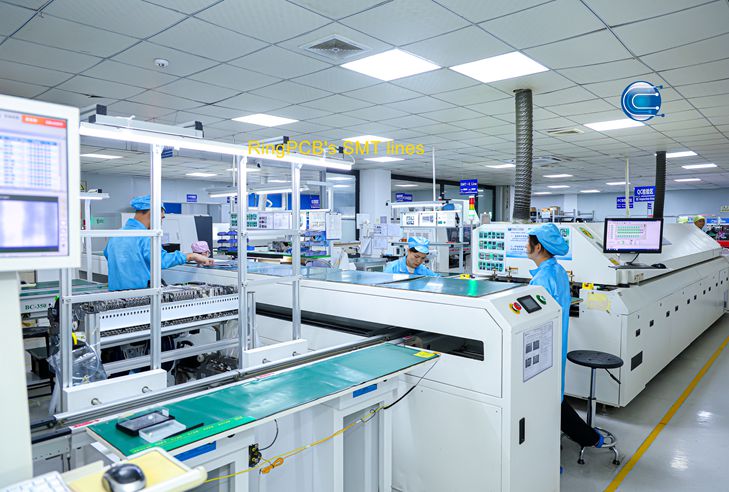
Ring PCB supports this process through multilayer and high-frequency PCB manufacturing, component sourcing, SMT and THT assembly, AOI and X-ray inspection, functional testing, and full-turnkey electronics manufacturing services.
For OEMs developing communication gateways, network controllers, wireless modules, or other communication equipment, early manufacturing collaboration can help identify sourcing and production risks before volume release.
Send your Gerber files, BOM, stackup specifications, assembly drawings, quantities, and testing requirements to rfq@ringpcb.com for project evaluation.
References
- Ericsson. Ericsson Mobility Report: 5G Subscriptions Top Three Billion as Uplink Gains Momentum. June 16, 2026.
- IPC. IPC Releases “J” Revisions to Two Leading Standards for Electronics Assembly. April 8, 2024
- Ring PCB. Full Turnkey PCB Assembly.
https://www.ringpcb.com/product/full-turnkey-pcb-assembly/
Core Keywords:
SEO Title:
SEO Meta Description: