
1. Why DFM Matters Before Ordering High Tg FR4 Heavy Copper PCBs
High Tg FR4 Heavy Copper PCBs are often specified for demanding applications involving power electronics, industrial control equipment and high-current circuits.
However, specifying a high Tg laminate and thick copper does not automatically guarantee that a board can be manufactured efficiently.
The combination of special materials, thick conductors and multilayer construction can influence material availability, fabrication yield, process complexity and production lead time.
For OEM purchasing and engineering teams, Design for Manufacturability (DFM) is therefore an important step before releasing the final PCB manufacturing package.
A structured DFM review helps identify technical conflicts early, improve manufacturing feasibility and reduce unnecessary production costs.

2. What Determines High Tg FR4 Heavy Copper PCB Cost?
The cost of a High Tg FR4 Heavy Copper PCB depends on several interconnected factors. Copper weight and laminate grade are important, but they are not the only cost drivers.
Laminate Material and Availability
High Tg FR-4 materials may have different resin formulations, thermal properties and supplier availability.
The selected grade can affect material cost, procurement lead time and compatibility with the required multilayer stackup.
If a project specifies a particular laminate model, the buyer should provide the exact material designation and relevant datasheet rather than using only the general term “High Tg FR-4.”
Material substitution should be reviewed and approved before production.
Copper Weight and Layer Distribution
Increasing copper thickness can affect more than raw material consumption.
It may require additional process compensation, more demanding etching conditions, specialized lamination planning and closer inspection.
The copper weight on each layer should be specified separately. Using heavy copper throughout the entire board may increase cost without providing meaningful benefits on low-current signal layers.
A mixed copper construction may be more economical when it meets the electrical and manufacturing requirements.
Board Size and Finished Thickness
Large board dimensions can affect material utilization and panel layout.
Similarly, thick multilayer boards may require different drilling, lamination and handling conditions.
The final quotation should therefore consider board size, thickness, layer count, panelization and production quantity together.
Trace Width, Spacing and Via Requirements
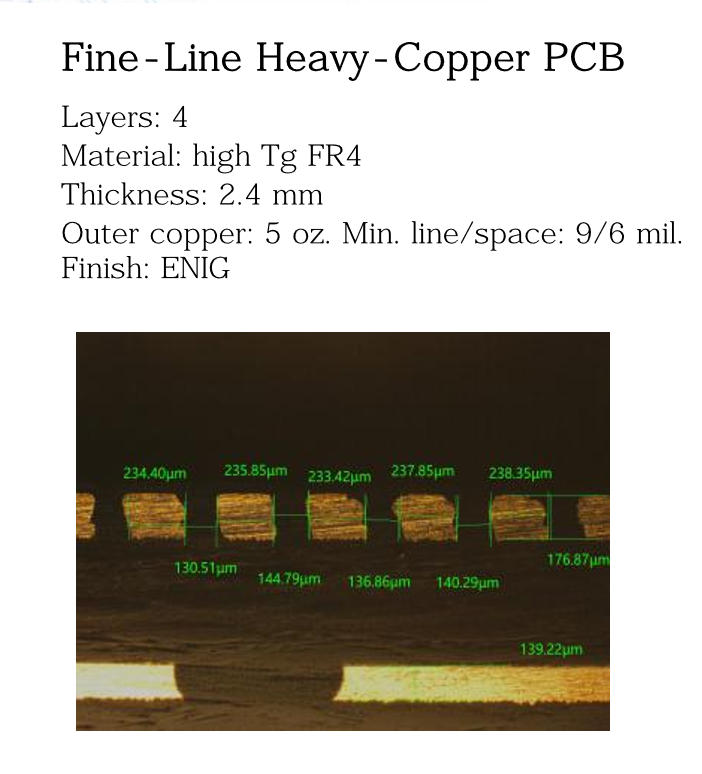
Heavy copper reduces the flexibility of fine-line etching because thicker conductors require greater etching depth and compensation.
If the design combines very thick copper with narrow traces and small spacing, manufacturing feasibility may become a major concern.
The via structure also influences cost. Drill diameter, aspect ratio, plating requirements and the number of interlayer connections should be reviewed during DFM.
3. Five DFM Checks Before PCB Manufacturing
A practical DFM review should examine the entire board construction instead of focusing on a single specification.
Check 1: Confirm the Copper Weight for Each Layer
Review the copper requirements for all layers.
Identify which layers carry high current and which primarily handle signal routing or control functions.
This helps avoid unnecessary heavy copper specifications and supports a more balanced manufacturing structure.
Check 2: Review Trace Width and Spacing
Check whether the proposed conductor dimensions are feasible for the specified copper thickness.
The manufacturer may need to recommend adjustments to artwork compensation, trace width or spacing based on its actual etching process.
Any changes should be discussed and approved before fabrication.
Check 3: Evaluate the Stackup and Resin Filling Requirements
The stackup should define:
- Core and prepreg materials
- Copper thickness for each layer
- Finished dielectric thickness
- Total board thickness
- Layer sequence and symmetry
For thick copper inner layers, the spaces between conductors can require additional resin during lamination.
The prepreg combination must be suitable for filling the copper topography while maintaining the required dielectric structure.
Check 4: Review Drilling and Plated-Hole Requirements
Confirm the drill sizes, finished hole dimensions, aspect ratio and plated-hole requirements.
For high-current designs, interlayer vias and plated connections should be evaluated as part of the complete electrical path.
Do not assume that a thicker surface trace automatically means the entire circuit path can carry the same current.
Check 5: Confirm Surface Finish and Assembly Compatibility
The selected surface finish should be compatible with the intended components and assembly process.
If the board will undergo lead-free reflow, the material’s thermal performance and the assembly profile should be reviewed together.
These checks help prevent a PCB specification from being technically acceptable on paper but difficult to manufacture consistently.
4. How to Reduce Heavy Copper PCB Manufacturing Costs Without Compromising Requirements
Cost optimization should focus on removing unnecessary complexity rather than reducing important performance requirements.
Several approaches can help.
Use Heavy Copper Only Where Needed
Assign heavier copper to power paths that require it. Standard copper can remain on layers where electrical requirements permit.
This can reduce material and process costs while retaining the required conductor cross-section.
Optimize the Layer Stackup
Review whether the selected layer count and copper distribution are necessary for the intended circuit functions.
A more balanced stackup can simplify lamination and improve manufacturing consistency.
Avoid Unnecessary Fine-Line Requirements
Thick copper and very narrow conductor geometry can create additional etching challenges.
Where the circuit permits, slightly wider traces and greater spacing can improve manufacturability and reduce process risk.
Select Available Materials
If several laminate grades meet the application’s thermal and electrical requirements, comparing their availability and lead times may improve purchasing flexibility.
Any alternative material must be reviewed against the original performance specification and approved by the customer.
Finalize Documentation Before Production
Repeated changes to Gerber files, stackup specifications or copper requirements can create additional engineering work and delay production.
A complete, controlled manufacturing package helps reduce unnecessary revisions.
5. How to Evaluate a High Tg FR4 Heavy Copper PCB Manufacturer
Choosing a PCB manufacturing supplier requires more than comparing unit prices.
OEMs should assess whether the supplier can handle the actual material combination and manufacturing requirements.
Heavy Copper Capability
Ask for the supplier’s supported copper range for both sample and mass production.
Clarify whether the stated copper weight refers to starting foil, finished copper or the specified layer construction.
Also confirm the supported layer count, board thickness and dimensional limits.
High Tg Material Experience
Check whether the supplier can process the required laminate and prepreg combination.
Request confirmation of the exact material model, applicable datasheet and any relevant process limitations.
Manufacturing and Inspection Equipment
Evaluate the supplier’s capability in imaging, etching, lamination, drilling, plating and electrical testing.
Ask how inspection is performed at important process stages, including inner-layer AOI, finished-board inspection and electrical testing.
Engineering Communication
A capable supplier should be able to identify potential conflicts between copper weight, trace geometry, stackup and manufacturing tolerances.
Clear communication during quotation and DFM review is important for avoiding unexpected changes after order placement.
Prototype-to-Production Consistency
Prototype feasibility does not automatically mean that the same construction can be transferred to mass production without adjustment.
Buyers should confirm whether the supplier can support the required production quantity and maintain the agreed specifications during scaling.
6. What Information Should Be Included in an RFQ?
To obtain an accurate quotation for a High Tg FR4 Heavy Copper PCB, customers should prepare:
- Gerber or ODB++ manufacturing files
- Layer count and complete stackup
- Exact High Tg FR-4 laminate designation
- Copper weight for each layer
- Finished board thickness and dimensions
- Trace width, spacing and drill requirements
- Surface finish and solder mask specifications
- Required electrical testing and acceptance criteria
- Prototype and mass production quantities
- Target delivery schedule and any special documentation requirements
The more complete the manufacturing information, the easier it is for the supplier to assess feasibility and provide a meaningful quotation.
7. High Tg FR4 Heavy Copper PCB Manufacturing at Ring PCB
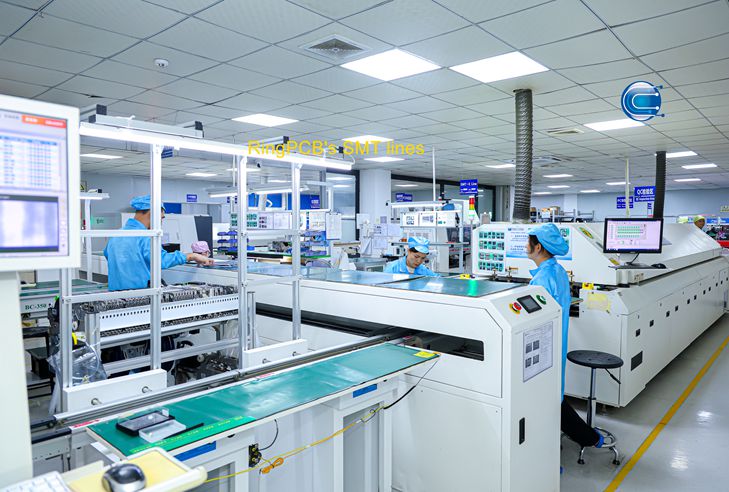
Ring PCB provides PCB fabrication services for customers requiring multilayer, High Tg FR-4 and Heavy Copper PCB constructions.
Established in 2008, Ring PCB operates a self-owned manufacturing facility covering more than 10,000 square meters.
Its published PCB manufacturing capabilities include:
- Up to 30 layers for mass production
- Up to 70 layers for sample projects
- Inner and outer copper up to 12 oz for mass production
- Copper up to 20 oz for sample projects
- Mass-production finished thickness from 0.3–6.0 mm
- Sample finished thickness from 0.2–10 mm
Ring PCB reviews material selection, stackup, copper distribution, board dimensions and manufacturing requirements according to each project’s specifications.
In addition to PCB fabrication, Ring PCB provides component sourcing, SMT assembly and through-hole assembly for customers requiring integrated PCBA manufacturing services.
Customers can submit Gerber files, stackup details and specific technical requirements for engineering communication and feasibility review before order confirmation.
Whether you are developing a new industrial power board or looking for a supplier for an existing Heavy Copper PCB project, Ring PCB can review your manufacturing requirements.
Contact rfq@ringpcb.com to discuss your High Tg FR4 Heavy Copper PCB project.
References
- HLCPCB. (2026). Heavy Copper PCB Manufacturing Supplier & Engineering Guide.
- Isola Group. IS420 High Performance Laminate and Prepreg.
- IPC. IPC-6012F: Qualification and Performance Specification for Rigid Printed Boards.
- IPC. IPC-2152: Standard for Determining Current-Carrying Capacity in Printed Board Design.